


Tuesday, May 25, 2010
Edith Widder on TED - things that glow in the sea
http://www.ted.com/
TED is an awesome website with talks by hundreds of people from all disciplines, and you can see them all free. They are pretty good. You should check it out. This one in particular caught my eye. Edith Widder does ocean and deep sea research and uses submersibles - pretty awesome stuff. Enjoy!

Tuesday, May 18, 2010
Here today, gone tomorrow!


A complete and utter failure? You decide. Last fall I had the bright idea to track overwinter survival and subsequent spring conditioning for scallops released in different habitats (eelgrass - their preferred habitat, see Thayer and Stuart 1974; Codium fragile - an introduced macroalgae which we think might serve as a suitable alternate substrate in the absence of eelgrass; and unvegetated, as a baseline for comparison). I have examined these habitats for growth in juvenile scallops and have already published some short term survival data (Carroll et al 2010, see earlier posts for a link). So my bright idea was to free release a fairly large number of scallops into these habitats at two field sites, one in Shinnecock Bay and one near Sag Harbor, NY. This is a method we have used in the restoration efforts, and a method that has been successful, so I figured that it would be no problem. I planted ~2500 scallops in each habitat at the 2 sites (~15,000 total scallops planted), not an insignificant number, at least not in my opinion back in November/December of 2009. In other planting sites, we typically don't monitor again after planting until the spring, so staying true to form, I did not actually go check on these scallops until last week. Much to my surprise (well, maybe not totally surprised) I didn't recover a single scallop in Shinnecock Bay. I surveyed all the habitats around my planting zone and didn't find a single live scallop, save for a couple natural 2 year olds. My dreams of having some uncaged growth and condition data failed! There wasn't even evidence of major predation, because I didn't even find empty or crushed shells. They were just all gone! A couple things are likely - either burial or transport - see Powers and Peterson's 2000 manuscript on scallop movement. Both are equally possible scenarios, as these sites in Shinnecock Bay were relatively shallow (~1m deep) and we had quite a crazy winter in terms of storms. Its just a shame. The only positive here is that at least my marker buoys were still firmly anchored at the sites! In fact, this picture is about the most exciting thing from the Shinnecock dives:

(thats right, its my pink lemonade by the throttle while the boat is tied to the dock. Nice, right?)
I was hoping Sag Harbor would be slightly better. I mean, this was a deeper site, so things had to work out, right? Actually, I originally expected there to be scallops at Shinnecock (typically low energy sites) and not in Sag Harbor (strong tidal currents). In Sag Harbor, the scallops already drifted slightly down current from the planting area the date of planting, and despite the scallops looking good at the bottom,
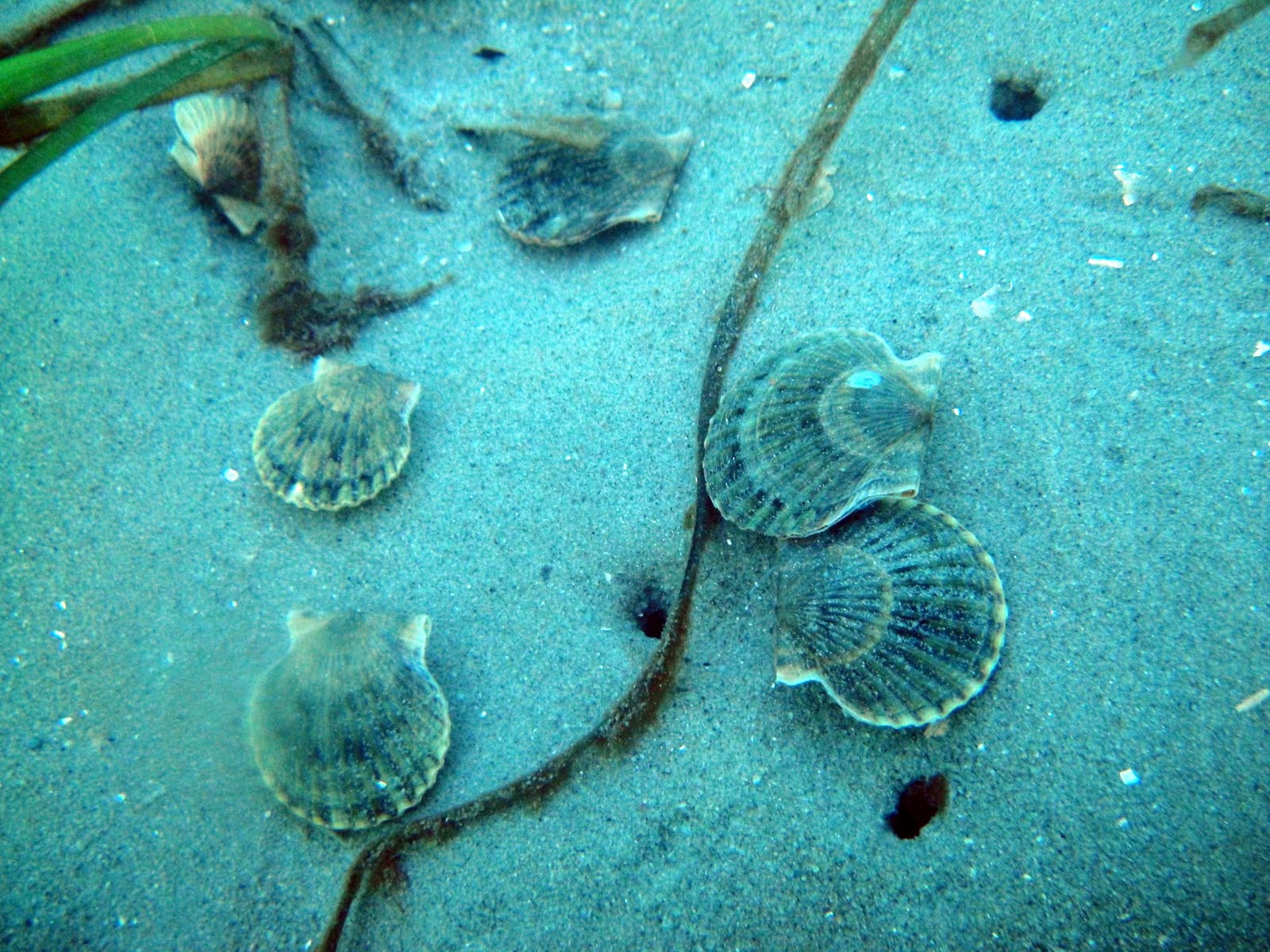
I figured strong currents and potential predation

I guess this season, I will just have to run juvenile growth experiments again, as soon as I get the juveniles.
At least I saw some cool stuff at Sag Harbor:

Spider crab crawling out from a cinder block.

Red beard sponge in eelgrass.

Surviving bay scallop, cryptically hidden on the bottom, save for its blue eyes!

Juvenile lady crab.
Thayer, GW, & Stuart, HH (1974). The bay scallop makes its bed of seagrass Marine Fisheries Review, 36, 27-30
Powers, SP, & Peterson, CH (2000). Conditional density dependence: The flow trigger to expression of density-dependent emigration in bay scallops Limnology and Oceanography, 45, 727-732
Sunday, May 16, 2010
Spring Surveys

At 2 of the sites we surveys we found scallops at higher densities than anticipated based on the fall survey results, suggesting higher overwinter survival (which can be a problem - Tettelbach et al 1990), and higher densities overall. These are very good signs, indicating that the restoration effort is likely working (and here, last years harvest is also a good indication, but see Tettelbach and Smith 2009)! Below are some photos from the dives....

Eelgrass, Zostera marina, often considered the primary bay scallop habitat, although some of our new research indicates that other species might also facilitate scallop survival - Carroll et al 2010

Some sort of tube worm, unsure what species...

The northern pipefish - pretty cryptic, huh?

A channeled whelk, or as the local baymen call them, "conch," now a top fished species in the Peconic Estuary

A sand collar, an egg casing laid by moonsnails.
Carroll, J., Peterson, B., Bonal, D., Weinstock, A., Smith, C., & Tettelbach, S. (2009). Comparative survival of bay scallops in eelgrass and the introduced alga, Codium fragile, in a New York estuary Marine Biology, 157 (2), 249-259 DOI: 10.1007/s00227-009-1312-0
Tettelbach, S.T., C.F. Smith, J.E. Kalady, T.W. Arroll and M.R. Denson. (1990). Burial of
transplanted bay scallops Argopecten irradians irradians (Lamarck, 1819) in winter. Journal of Shellfish Research, 9, 127-134
Tettelbach, S., & Smith, C. (2009). Bay Scallop Restoration in New York Ecological Restoration, 27 (1), 20-22 DOI: 10.3368/er.27.1.20
Saturday, May 15, 2010
What invert you like
Saw this video at the Benthic Ecology Meetings in Wilmington NC, it talks about benthic invertebrates to the tune of "Whatever you like" (whatever that is)...
It was made by Jeremy Long of San Diego State University.
It was made by Jeremy Long of San Diego State University.
Check out newsday's photo slide show...
on the scallop restoration efforts in Long Island...
http://www.newsday.com/long-island/scallops-in-long-island-s-hallock-bay-photos-1.1878136#1
I have worked on both the barge in the photos that is shown hauling the lantern nets full of scallops and on the small boat which is seen in the photos of Dr Steve Tettelbach.
http://www.newsday.com/long-island/scallops-in-long-island-s-hallock-bay-photos-1.1878136#1
I have worked on both the barge in the photos that is shown hauling the lantern nets full of scallops and on the small boat which is seen in the photos of Dr Steve Tettelbach.
Some pictures from the other day...
Some of the sea life on the bottom in Hallock Bay, Long Island, NY.

A pipefish!

Small fish, probably a grubby sculpin.

A chiton!

Green brittle star - there are lots of these guys at our Hallock Bay planting site, although I am not sure exactly who they are.

Long claw hermit crab, Pagurus longicarpus

Can you pick out the sand shrimp, Crangon septemspinosa?

This is an angry mud crab, probably of the genus Dyspanopeus, upset that I am bothering him

An agitated spider crab of the Libinia genus in my quadrat!

Hard clam siphon

Juvenile spider crab crawling through the algae
Also, check out my recent manuscript.
Carroll, J., Peterson, B., Bonal, D., Weinstock, A., Smith, C., & Tettelbach, S. (2009). Comparative survival of bay scallops in eelgrass and the introduced alga, Codium fragile, in a New York estuary Marine Biology, 157 (2), 249-259 DOI: 10.1007/s00227-009-1312-0
Wednesday, April 28, 2010
Wow, that was refreshing
Well, it was a long winter. Maybe not any longer than usual, but waiting to get back in the water seemed to take longer than it has in years past. It might be because I've been feeling unproductive (as sometimes happens when I'm stir crazy in the lab, waiting for a nice day to get outside). Or maybe its because a couple of labmates of mine, Chuck Wall and Jamie Brisbin have been in the water since January. Whatever the reason, yesterday, April 27th, could not have come early enough. It's pretty incredible diving early in the season - cold, relatively clear water, and although not a lot of activity, those organisms that are active are still pretty slow and easy to observe and photograph (pictures to follow). I got to try out my new semi-dry suit by Bare, and my new fins with spring straps! which I purchased at Treasure Cove Divers in New Jersey. First, the suit works great, but semi-dry is kind of a misnomer. I imagine its supposed to let less water in through tighter seals, however, it still lets water in and you still get wet. But I was still very pleased with the suit and while cold (although at 11C, I suppose not terribly cold), I was fairly comfortable. I also brought my new Sea and Sea DX-1G camera out in the field in New York for the first time, and the results are mixed. I am pleased with my photos when I was in Fiji, but that was relatively clear water. It also doesn't help that I am only an amateur photographer, and not necessarily even a good one at that, but I hope to get yesterdays photos cleaned up and posted here soon.
As for the actual purpose of the expedition, SCALLOPS! Our free planting area in Hallock Bay has once again had great success in overwitnering. Additionally, we have experienced high survival through their 2nd (!) winter of scallops planted in 2008, to the tune of 8-10 mer square meter! That is pretty incredible, since the mantra is that most scallops don't survive their second winter. We will keep monitoring these guys to see if they survive through spawning, but it was pretty unexpected and pretty encouraging. As for those scallops planted last winter, we have again experienced great success in survival and will now continue to monitor this site every 2 weeks until August. Scallops on the long lines also survived at very high rates AND have even showed some remarkable growth this early in the season. All in all, a very nice day for diving and some very good results.
As for the actual purpose of the expedition, SCALLOPS! Our free planting area in Hallock Bay has once again had great success in overwitnering. Additionally, we have experienced high survival through their 2nd (!) winter of scallops planted in 2008, to the tune of 8-10 mer square meter! That is pretty incredible, since the mantra is that most scallops don't survive their second winter. We will keep monitoring these guys to see if they survive through spawning, but it was pretty unexpected and pretty encouraging. As for those scallops planted last winter, we have again experienced great success in survival and will now continue to monitor this site every 2 weeks until August. Scallops on the long lines also survived at very high rates AND have even showed some remarkable growth this early in the season. All in all, a very nice day for diving and some very good results.
Subscribe to:
Posts (Atom)


