Monday, February 16, 2009
My personal fish tank
No scallop news to report this time of year. I am in the process of getting my proposal together to defend it this spring, re-writing a manuscript, getting together a presentation for the upcoming Benthic Ecology Meetings, and taking two classes. Crazy right? But somehow, I have found time to renew an old hobby of mine, tropical fishkeeping. When I was growing up, my dad always had fish tanks, and when I was old enough, I started getting tanks of my own. Eventually, between me and my father, we had somewhere between 13-15 fish tanks throughout the house and basement. I tried to continue the hobby in college, but it is hard when you move every 8 months. So I have been out of the hobby for a few years, but was able to obtain a 20 gallon fish tank last September, and I set it up with freshwater (marine ornamentals are difficult and expensive, both in livestock and equipment). Originally, I just had some tetras (lemon tetras mostly) and after the tank cycled, I added some neons as well. After Christmas break, I added some angelfish and catfish. But I always wanted discus. They are some of the most difficult freshwater fish to keep, requiring very specific water quality (low pH, soft water, low nitrogen, high temperature). My father and I tried to keep them a long time ago, but kept having difficulty - which was disheartening, considering we had kept just about every other type of freshwater fish with relatively few problems. Discus are kind of like the holy grail of freshwater fish - breeders kept secrets for decades. But when I went to the pet store the other day, I saw discus at the right size (silver dollar) and the right price (29.99, 4 for 100). My water seemed right (temp ~80, but easily raised, pH ~6, etc) but I still wasn't sure. I probably wouldn't see discus this quality at this price again (especially if the economy gets fixed), but I had two angelfish (body size ~ a quarter) who were now established in the tank for over a month, and the tank was small. Both angelfish and discus are specialized cichlids from the floodwaters of the Amazon river, laterally compressed to swim between the submerged trees. Cichlids, by nature, can be rather territorial and aggressive by nature, and although angelfish and discus are generally regarded as gentle, there was some hesitation on my part. 20 gallon tanks are small - only 24 inches long - and with the angels being established, there isn't room for the discus to escape potential attacks. I thought long and hard. I spent about an hour watching the fish and talking to the store attendant. Finally I decided I won't have another opportunity to get the discus at this price, and I figured I would give it a try. This was yesterday. They seemed to acclimate fine, however, I raised the temperature in my tank anyway, from 80 to 85 (I was hoping only to come up to 82-82, but my heater is not that specific). Then I turned off the light and went to bed. I forgot to consider the potential for the dissolved oxygen to drop when I raise water temperature, and I woke up this morning with all the former residents (tetras and angels) gasping for air, and one of the catfish already dead. I was freaking out. I could not have this. I dropped the temperature back down to just over 80, took an inch of water out so the filter exhaust would stir the water better, and rushed to school to borrow an air pump for the time being. But I had class, so I couldn't stay and watch. I just kept my fingers crossed. When I got home today, I was surprised. All the fish seemed to be breather normally, swimming around, and all were eating (even the discus, after only 1 day!) Catastrophe averted, for now. I will take pictures soon.

Monday, January 19, 2009
Atlantic sharks at risk due to over-fishing - Devastating for scallops?

The cracked bay scallop shell indicates crab predation.
Over-fishing is a relatively hot topic these days. One group of fishes that are particularly threatened are sharks - because they are large, long lived, and have relatively few offspring. Here an excerpt from a recent article online:
"GENEVA – More than a quarter of sharks in the northeast Atlantic Ocean face extinction with some species already wiped out in certain areas due to over-fishing, a conservation group said on Monday.
Twenty-six percent of sharks, rays and chimaeras are threatened with extinction and another 20 percent are in the 'near threatened' category, the Switzerland-based International Union for the Conservation of Nature (IUCN) said in a statement."
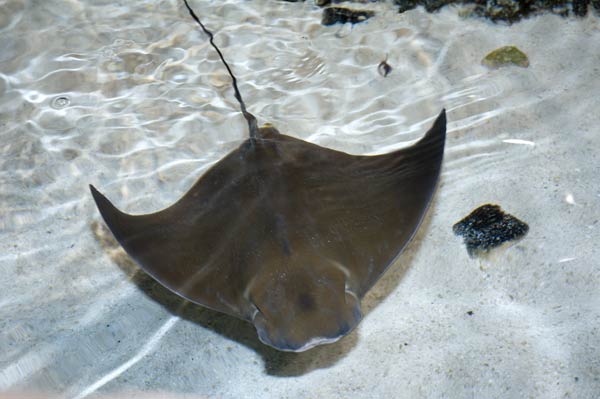
This has the potential to be devastating to bay scallops. With the loss of sharks, which are large apex predators, their prey is released from a predation pressure. This, in turn, allows populations of shark prey to expand - these include smaller sharks, skates, and rays, which are typically benthic feeders which eat shellfish. One species in particular has increased to such numbers, the cownose ray, that it has devastated the bay scallop fishery in North Carolina. This has been documented by scientists for the past 8 years, and recently made Science magazine in 2007. Luckily, we don't have the large feeding aggregations of cownose rays here in New York, and as far as I can tell, we haven't seen large increases in skates, at least not in areas where we have bay scallop populations.
Although it is possible that we are seeing other trophic cascade-type effects, some of which I plan to investigate in my thesis research. I don't want to get into too many details until I know if I am doing this for sure, but its possible that loss of some local fishes has released crabs from predation pressure, allowing them to forage more freely on their prey, juvenile bay scallops included. By the way, I am working on my proposal right now and it is killing me! Can't wait until it is all over!
Thursday, January 15, 2009
"Nub" scallops

Most bay scallops live less than 2 years, and so a concentric growth ring is usually only laid down once. Typically seed scallops reach a size threshold, 35-55mm by the end of their first growing season. However, some scallops are less than 20mm when the growth ring is set. These could be the product of fall spawns, and there is some thought that these scallops don't spawn before they are large enough for their first harvest, that is, they are likely to live into and spawn in a 2nd year. Some populations consist of more than 50% of these "nub" scallops. This has been a particular problem in places like Nantucket, where large portions of scallops have small growth rings. In order to harvest a bay scallop, it must have a clear growth ring, however, "nub" scallops have such small rings, they often appear as ringless adults. This has drastically shrunk the harvest of scallops in this area. That is, until this year, when an emergency regulation was passed to save the harvest. The legislation stated that now scallops could be harvested if they were greater than 2.5 inches in shell height OR if they had a 10mm growth ring - this means that ringless adults (nub scallops) can be harvested if they are greater than 2.5 inches. I don't know if I agree about this legislation, mostly because very little is known about nub scallops and their potential importance for spawning in the 2nd year. I did think it was interesting that bay scallops have been in the news recently.

The photos were taken by Steve Tettelbach and borrowed from a poster presented at last year's 100th annual National Shellfish Association meeting.
Monday, January 12, 2009
It's been such a long time...


I can't believe it has been so long since I last posted. I had a busier than anticipated end of the season. I was still diving the week before christmas, and luckily the season ended then, because on my last dive day, the neck seal on my drysuit broke. It was weird, usually the seal might crack or tear, but when I was suiting up, a chunk came off the neck, almost like a cookie cutter was used. But anyway, that was the last day, and it should hopefully be fixed before the season starts again in March-April. Otherwise, we planted ~200,000 scallops at a couple sites this year. We tried 2 new sites because we had a macroalgae overgrowth problem last winter, which led to anoxia at the sediment surface and likely decimated our scallop plantings there (>90% loss). This time of year is slow, but I am still very busy. I am working on a new draft of my last manuscript, hoping to address all the issues brought up by the previous reviewers. I am also trying to put together my PhD dissertation committee and write my proposal. Ideally, I will finish writing and defend my proposal before May, this way I can make adjustments for the next field season. So we shall see. Right now all I have is an outline, but at least thats a start. I am also trying to finish processing my samples from the summer, but still have over 100 scallops left to go. That doesn't seem like much, true, but I can only do about 30 scallops at a time - there is limited space in our drying oven - and I have to wait 2 days to finish the processing, so it takes some time. I am also going to make more grass mats for this summer, so that should start to consume my time as well. To top it off, I am registered for 2 classes in the spring, so I can honestly admit I have a full schedule in the spring. But its not too bad, and I am looking forward to taking the next step toward attaining my PhD.
Wednesday, October 22, 2008
Bubbles, bubbles everywhere, but not a drop to drink...

Adult bay scallop in a Codium fragile bed
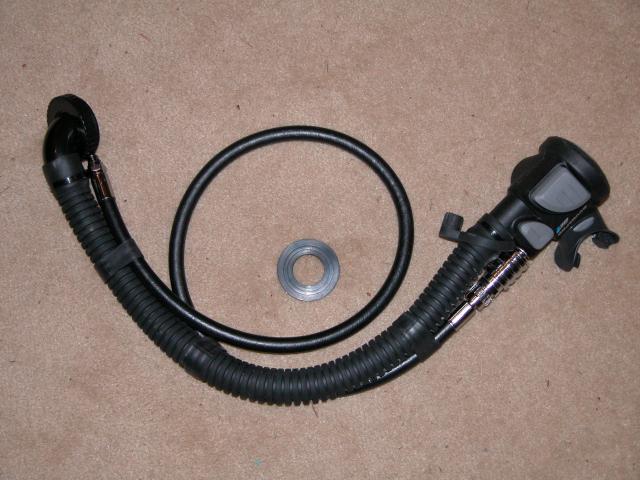
Well, there were certainly a lot of bubbles yesterday. I went diving, but in addition to the normal exhalent bubbles from every breath, my Air2 was leaking, creating more bubbles and increasing my apparent air intake. But that didn't stop me from doing my transect surveys at 5 sites in the Peconics. We stopped all around Northwest Harbor (East Hampton, NY) and Sag Harbor, and then 1 dive in Southold Bay. While we didn't see as many scallops as we would have liked, we did see a few, which was good. In most places, we saw more seed

A seed bay scallop in Codium

A bay scallop "smiling" for the camera... Old Blue eyes


A seed bay scallop, note the darker mantle than the one above
than adults,

An adult bay scallop with its epiphytic and epizooic growth
which is good and bad. It is good in that hopefully there are enough seed to survive over the winter and spawn next year. It is bad for the commercial and recreational guys that there aren't enough adult scallops (potentially) to go around. Who knows how this year ends up. However, I did see a decent number of scallops,
small fish,

hermit crabs,


spider crabs,

mud crabs,

grass shrimp,


whelks,


your usual suspects. A nice day diving, although cold (12.5C). Its about time to break out my drysuit. The visibility and diving this time of the year is the best though, so I won't complain. Going again on Friday. Stay tuned.
Tuesday, October 21, 2008
Another day, another 100,000 scallops

Or something like that... Last Thursday, October 16th, I went diving out in Flanders Bay. We were doing a bottom survey of a previous free release spot for scallops, since we were preparing to release ~100,000 seed scallops as part of the restoration efforts going on in Long Island.


Flanders for a very long time sustained a sizeable scallop population even inthe absence of eelgrass (Zostera marina). But land use changes in addition to the brown tides more than likely led to their demise in that area. Luckily, a year after last years plantings, there were still ~ 1 per square meter, much lower than stocking, but still a decent number.


After surveys, we set up an area to plant new scallops, at ~ 100 per square meter. We hope to dive on the site once more before it gets too cold, and then start again in the spring. Hopefully this will help jump-start a population in Flanders.


Additionally, I saw some really cool things... including a porgy trying to eat leftovers from a whelk feeding,

a whelk eating a newly planted scallop,


and a large northern puffer, which are rare nowadays due to overfishing.


Oh and this mean looking guy.

And tons of cool shells.


All in all, it was a pretty cool day of diving. Not only was I a part of the free release, I was able to see some cool things, like direct predation, swimming scallops (which are impossible to get a photo of, in case you were wondering why there isn't one) and that puffer really made my day.
Tuesday, October 14, 2008
Failure to launch, er, or settle, or recruit...

Yes, that is right. Failure. I guess it happens to everyone, and I half expected it by the way my recruitment experiment was going all summer. But I did get that glimmer of hope 6 weeks ago, when I did find a handful of scallop spat on my recruitment squares, and both 4 weeks ago and last week when I saw numerous scallops in our local spat collectors. Alas, no recruits on my squares. That old adage of "If you build it, they will come" does not seem to be ringing true for scallop spat in my grass mats.

Now, I don't want to make this all bad, because clearly highly mobile macrofauna have had no problems discovering or inhabiting my artificial grass mats. In fact, with the water relatively clear last week, I saw numerous species, including tomcod (which I had not seen in Hallock in all my dives there), largish sea bass, and the usual suspects (killifish, pipefish, sticklebacks, cunner, blackfish, porgies). So the whole "if you build it, they will come" theory behind creating artificial habitats or restoring habitats may ring true for certain mobile organisms. However, habitat value aside, no habitat can encourage organsisms to come if those organisms can not get there. Simple. If the supply is low, which I have reason to expect that it is (judging by the almost complete absence of adult scallops from the bay, among other things), it cannot be compensated by available habitat. However, it is still quite possible that I am simply missing the spat on my collecters, since collecting approximately 1 square meters worth of recruitment squares (~500 shoots) out of ~119 square meters of areas (~59000 shoots) may just be too small an amount to see anything. Finding scallop spat on natural grass is akin to finding a needle in a haystack, so why would my mats have been any different? And yes, the number of squares I collect seems low relative to the total area, but over the course of the whole summer, I collected ~5 square meters worth of artificial grass mats, with essentially the same result every time, nothing. Given the amount of hours it takes to locate and collect the squares, then process them, it is alot of work, trust me on that. It just seems to me that supply is very low. Even in the collectors we aren't getting that many, 10-20 per collector, and those are on a mesh that has more surface area than my recruitment squares and are enclosed and thus less likely to be preyed upon. My recruitment squares also don't have that luxury, and I did this on purpose. Maybe next year I will do a predicted vs apparent recruitment survey. I know I am missing some, since we did collect one large seed ~30mm on one of my squares, but not attached to my grass. At least this is a good sign that there are probably some seed out there, and I am hoping in November to do some bottom surveys to find out.
Subscribe to:
Posts (Atom)