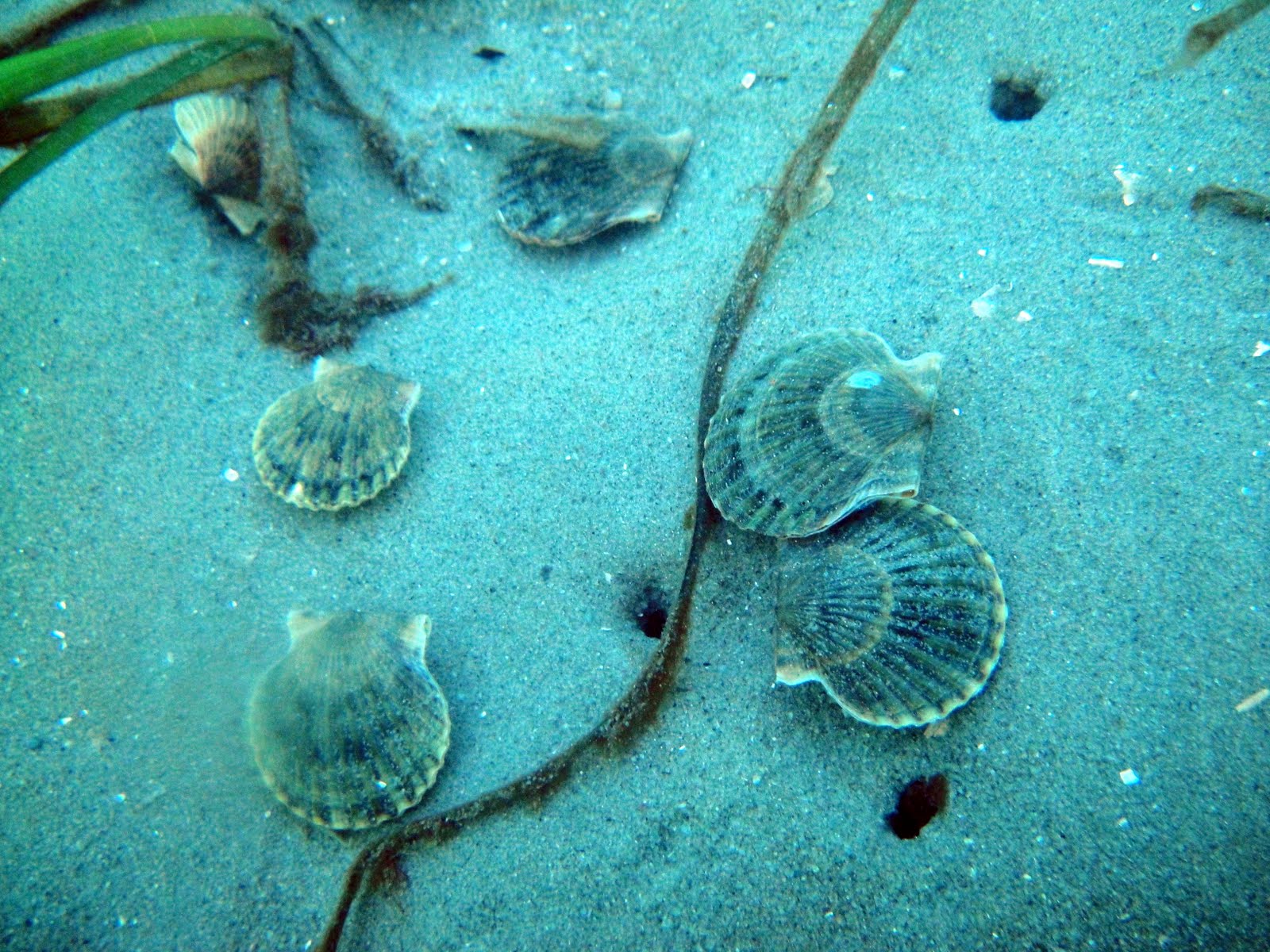
Zostera marina is a seagrass species, commonly known as eelgrass, that is found on both coasts of the United States, as well as in Europe. Unfortunately, Zostera is disappearing all over the place, including right here in New York. This could have devastating impacts on animals that rely on eelgrass as foraging grounds, or, as is the case with scallops, use it as a refuge from predation. This is its story, as seen through the eyes of an aspiring graduate student...

Thursday, June 24, 2010

Atlantic Cod and Eelgrass, oh my!


Well, now I've seen everything. Well maybe not everything, but in all my NY diving, I had never seen this: eelgrass on an exposed, essentially oceanic sandy, rocky bottom, and a school of YOY cod. I have heard about eelgrass in these locations. I have heard that there have been increasing cod landings in NY over the past 2 winters. I have even read that juvenile cod utilize eelgrass. But I had never actually seen it until last week, when we dove along the south-western corner of Fisher's Island.
ResearchBlogging.org
We were out there for the day looking at some eelgrass for some new projects we are working on in the lab and in addition to collect samples for genetic analysis for a colleague's (Jamie Brisbin's) research. After we were done at our site for the day, we decided to take a quick drop in along the exposed southern shore where the grass was supposed to be extremely tall and growing in a relatively rocky habitat. It was a pretty cool site - I saw typically rocky subtidal macroalgae - kelps, fucoids, coralline - with patchy eelgrass mixed in. It was pretty exciting and cool to see (although my picture below hardly does it justice).


But while I was down there, I was surrounded by what appeared to me to be young of the year (or at the most young juvenile) cod. I am in no means a fish biologist, so I might be off a bit in estimating their age, but they were definitely gadiforms, and I am fairly confident they were Atlantic cod, Gadus morhua. The distinguishing feature for me was the 3 dorsal fins. Either way, I was surprised to be surrounded by this school, although again, these pictures do them no justice. I found it difficult to get good photos - it was late in the day, the water was surgey (I just made up a word I think), and I just couldn't get very close, so I was limited by the capabilities of my Sea and Sea camera. That didn't stop me from trying, mind you. I was swimming, hands extended in front of me and (don't try this at home) holding my breath while diving and snapping away. Everytime I let out a breath, they would swim away. This is poor diving practice, and I wasn't holding my breath for long - just slightly longer than my normal breathing rhythms - it was just my best chance at getting any shots at all.


But then I realized, wow, these are a bunch of young cod and they are staying in this area where there is eelgrass. And I remembered an article I read about YOY cod and survival in eelgrass meadows. And since my experiences with eelgrass have always been in lagoonal-type estuaries where we don't see cod (although we do see their cousins Atlantic tomcod and hake), I was excited to see both eelgrass and cod in the same place (mind you, I had never seen cod while diving either). So I was sitting on the bottom, trying to follow this school of fish and get any good pictures, and thought this is what that paper was talking about. I will detail the paper below.


The basic idea behind the paper by Ann Marie Gorman et al in 2009 was this idea of habitat patch size and edge effects on juvenile cod. I was particularly interested in this paper because the impacts of eelgrass patch morphometrics is something I have spent considerable time working on in regards to bay scallops - my research organism. So any manuscript pertaining to seagrass patch effects I try to read. This paper was pertaining to Atlantic cod, predatory mortality, and edge effects, all things of significance to my research. Since young of the year cod utilize coastal eelgrass habitats as nurseries and predation refuges, varying sizes of patches can have considerable impacts on juvenile survival. The group investigated different size patches, as well as within patch location (along the patch edge, 5 and 10 meters into the patch and into the unvegetated sediment outside the patch), and how those two factors affected the survival of tethered age-0 cod. Obviously, there are all sorts of potential artifacts with tethering mobile individuals in survival studies, however, because they are mobile, there is no other way to look at predatory mortality as specific locations within a given habitat. They observed a relationship which demonstrated lowest survival at intermediate patch sizes and highest survival at the largest patch sizes. And interestingly, they had lowest survival of tethered scallops along the eelgrass patch edge than either within the patch or in the barren habitat - and this survival increased with distance from the edge in both directions. This has been observed in other seagrass habitats, so I bought this. It solidifies the hypothesis that predators in seagrass habitats patrol along the edge of the seagrass, where prey densities are likely to be higher than in unvegetated habitats, and more easily accessible than within the seagrass patch. An interested read for those interested in spatial and landscape ecology, impacts of habitat patchiness on survival, or finifsh predation.

Gorman, A., Gregory, R., & Schneider, D. (2009). Eelgrass patch size and proximity to the patch edge affect predation risk of recently settled age 0 cod (Gadus) Journal of Experimental Marine Biology and Ecology, 371 (1), 1-9 DOI: 10.1016/j.jembe.2008.12.008

Friday, June 4, 2010

Marine ecology affected by the local weather


ResearchBlogging.orgAs marine scientists, sometimes we forget or don't even realize how much local baymen and fishermen actually know. Or maybe we don't trust them because they are "lay" persons. But they work the bay, they try to catch many of the species we study (as money is a big driver of research), and they know things. Local baymen who have worked the bay for years suggest that bay scallop recruitment is higher in years after cold/wet winters. Sometimes, we take what they say with a grain of salt. However, they know. They have often been working with these species for as long or longer than we have, and it is often also a generation thing. Generations of baymen can't be wrong in their assessment, can they?

A 2001 study in the Dutch Wadden Sea supports these claims, however, their conclusions are not what you think. Matthius Strasser and Carmen-Pia Gunther observed patterns in larval supply of predators and prey after a series of consecutive winters in which temperatures were severe, moderate or mild. Originally, the prevailing thought was that egg production increased after severe winters of many benthos, and this is why recruitment was higher in the following spring. However, their research indicates that the numbers and peaks in recruitment were actually highest in the mild winter. So why isn't recruitment highest during these years? Their theory, a mismatch in the predator and prey larval supply. After severe winters there is a delay in the peak larval supply of the major predators, green crabs, of almost 6-8 weeks. This delay is not as apparent as their bivalve prey, and with the average larval time of the bivalves also being shorter, they settle much earlier than the green crabs and have a potential head start in growth. According to the researchers, this mismatch is what fuels observations of higher recruitment after severe winters.

An alternative scenario is one which was observed in Chesapeake Bay. Using local climate response variables Kimmel et al were able to demonstrate noticeable and significant differences in phytoplankton, copepod, gelatinous zooplankton and finfish abundances and composition between years with "wet" winters and years with "dry" winters. Essentially, wet winters led to an increase of freshwater flow and nutrients into the system, which resulted in higher phytoplankton, more copepods, more ctenophores and higher numbers of striped bass. In years of dry winters, there was less phytoplankton, more scyphomedusae and more menhaden. The basic premise is that the local climate had a significant impact on the community composition of Chesapeake Bay by controlling the amount of fresh water flux into the system.

Both are interesting reads, and the idea of the interplay between climate and marine ecology is one that is becoming even more important to understand with the current climate change scenarios. It is quite clear that atmospheric conditions and local climate can have a fairly significant impact on subsequent year classes - something baymen have been familiar with for decades, if not centuries, but something marine scientists have only been exploring for the past decade, give or take.

Strasser, M. (2001). Larval supply of predator and prey: temporal mismatch between crabs and bivalves after a severe winter in the Wadden Sea Journal of Sea Research, 46 (1), 57-67 DOI: 10.1016/S1385-1101(01)00063-6

Kimmel, D., Miller, W., Harding, L., Houde, E., & Roman, M. (2009). Estuarine Ecosystem Response Captured Using a Synoptic Climatology Estuaries and Coasts, 32 (3), 403-409 DOI: 10.1007/s12237-009-9147-y

Monday, May 31, 2010

Whacthu talkin 'bout? Ocean warming strengthens scallop recruitment?


ResearchBlogging.org
Apparently, climate change might not be such a bad thing. Especially not if you are an exploited species of bivalve. Now I am not trying to be a climate change apologist, but too often we get caught up in this debate and science is 99% of the time on the side saying "It's bad." However, as I have learned in my own research with invasive species, there are always two sides to every coin. A warming ocean could be a benefit to numerous species, probably as many species as it might be of detriment. Obviously, there are a whole suite of ecosystem processes that are also affected, but in certain cases, it might not be so bad. At least not according to a paper in Marine Biology entitled "Strengthening recruitment of exploited scallops Pecten maximus with ocean warming." Its an interesting read. The essential idea is that over a long(ish) time period, the researchers were able to demonstrate a highly significant correlation between increasing temperature and increasing settlement and recruitment of juvenile scallops to a local scallop population. Shifts in recruitment can be attributed to temperature related shifts in feeding, gonad development and larval survival - and this impacts are more apparent in species who use environmental cues to induce development and spawning. Such is the case for many species of bivalves, including scallops, and so a warming ocean could potentially enhance scallop recruitment. There are some stats involved in their methods, but the basic results are pretty simple, over the past decade, scallop landings around the Isle of Man have been increasing. IN addition, mean springtime temperatures have been increasing (which cues development). I know what you all might be thinking, correlation does not equal causation (you know the one, mean global temperature has increased as the number of global pirates has decreased, meaning that the number of pirates somehow influences the climate), but that goes into their methods of using residuals and proxy values and all sorts of things. Basically, recruitment increase isn't significantly related to other things (spawning stock, dissolved oxygen, chlorophyll a), and is strongly related to temperature. They even examined a number of scallops during the three month conditioning period and the GSI - which indicates relative gonad development - was significantly higher in years when temperature was higher. So when temperature goes up, the scallops develop larger gonads and subsequently release more larvae which show up as strong recruitment classes.

So what does this mean for bay scallops? Well, there are plenty of issues with ocean warming and bay scallops - and one of particular concern is predator range expansion and new predators coming into the bay scallops range. In terms of recruitment, we haven't seen any patterns that would suggest this is the case in New York. However, there hasn't been many scallops here to spawn over the past 20 years until recently - due to the restoration efforts - and there needs to be a local spawning population in order to observe any of the patterns described from the paper. That said, bay scallop recruitment is not likely to be effected by ocean warming in terms of larger populations - although timing of first spawn might change, the number of times they spawn might change, etc, but it is my opinion that there are numerous variables that influence the size of recruitment classes in local scallop populations, particularly in the bay, which is already a dynamic environment.


Shephard, S., Beukers-Stewart, B., Hiddink, J., Brand, A., & Kaiser, M. (2009). Strengthening recruitment of exploited scallops Pecten maximus with ocean warming Marine Biology, 157 (1), 91-97 DOI: 10.1007/s00227-009-1298-7

Tuesday, May 25, 2010

Edith Widder on TED - things that glow in the sea


http://www.ted.com/

TED is an awesome website with talks by hundreds of people from all disciplines, and you can see them all free. They are pretty good. You should check it out. This one in particular caught my eye. Edith Widder does ocean and deep sea research and uses submersibles - pretty awesome stuff. Enjoy!

Tuesday, May 18, 2010

Here today, gone tomorrow!


ResearchBlogging.org
A complete and utter failure? You decide. Last fall I had the bright idea to track overwinter survival and subsequent spring conditioning for scallops released in different habitats (eelgrass - their preferred habitat, see Thayer and Stuart 1974; Codium fragile - an introduced macroalgae which we think might serve as a suitable alternate substrate in the absence of eelgrass; and unvegetated, as a baseline for comparison). I have examined these habitats for growth in juvenile scallops and have already published some short term survival data (Carroll et al 2010, see earlier posts for a link). So my bright idea was to free release a fairly large number of scallops into these habitats at two field sites, one in Shinnecock Bay and one near Sag Harbor, NY. This is a method we have used in the restoration efforts, and a method that has been successful, so I figured that it would be no problem. I planted ~2500 scallops in each habitat at the 2 sites (~15,000 total scallops planted), not an insignificant number, at least not in my opinion back in November/December of 2009. In other planting sites, we typically don't monitor again after planting until the spring, so staying true to form, I did not actually go check on these scallops until last week. Much to my surprise (well, maybe not totally surprised) I didn't recover a single scallop in Shinnecock Bay. I surveyed all the habitats around my planting zone and didn't find a single live scallop, save for a couple natural 2 year olds. My dreams of having some uncaged growth and condition data failed! There wasn't even evidence of major predation, because I didn't even find empty or crushed shells. They were just all gone! A couple things are likely - either burial or transport - see Powers and Peterson's 2000 manuscript on scallop movement. Both are equally possible scenarios, as these sites in Shinnecock Bay were relatively shallow (~1m deep) and we had quite a crazy winter in terms of storms. Its just a shame. The only positive here is that at least my marker buoys were still firmly anchored at the sites! In fact, this picture is about the most exciting thing from the Shinnecock dives:

(thats right, its my pink lemonade by the throttle while the boat is tied to the dock. Nice, right?)

I was hoping Sag Harbor would be slightly better. I mean, this was a deeper site, so things had to work out, right? Actually, I originally expected there to be scallops at Shinnecock (typically low energy sites) and not in Sag Harbor (strong tidal currents). In Sag Harbor, the scallops already drifted slightly down current from the planting area the date of planting, and despite the scallops looking good at the bottom,

I figured strong currents and potential predation

would essentially eliminate them. Luckily, there was scallops to be found in Sag Harbor, although in much reduced densities. So, not enough scallops to monitor with enough replication to have confidence in the results, but at least all of the 7500 scallops here were not lost. What was lost, you ask? The Codium! It was all gone! My Codium planting area in Sag Harbor was completely devoid of Codium! So despite the semi-success of overwintering some of the scallops in Sag Harbor, my experiment here still failed! Awesome! I guess there's always NEXT year, I just don't know how my committee feels about that!
I guess this season, I will just have to run juvenile growth experiments again, as soon as I get the juveniles.

At least I saw some cool stuff at Sag Harbor:

Spider crab crawling out from a cinder block.

Red beard sponge in eelgrass.


Surviving bay scallop, cryptically hidden on the bottom, save for its blue eyes!

Juvenile lady crab.

Thayer, GW, & Stuart, HH (1974). The bay scallop makes its bed of seagrass Marine Fisheries Review, 36, 27-30

Powers, SP, & Peterson, CH (2000). Conditional density dependence: The flow trigger to expression of density-dependent emigration in bay scallops Limnology and Oceanography, 45, 727-732

Sunday, May 16, 2010

Spring Surveys


We are just about done with our spring benthic surveys in the Peconic Estuary. On Wednesday we surveyed a couple of sites around Orient Harbor, the location of the large suspended spawner sanctuary.

At 2 of the sites we surveys we found scallops at higher densities than anticipated based on the fall survey results, suggesting higher overwinter survival (which can be a problem - Tettelbach et al 1990), and higher densities overall. These are very good signs, indicating that the restoration effort is likely working (and here, last years harvest is also a good indication, but see Tettelbach and Smith 2009)! Below are some photos from the dives....

Eelgrass, Zostera marina, often considered the primary bay scallop habitat, although some of our new research indicates that other species might also facilitate scallop survival - Carroll et al 2010


Some sort of tube worm, unsure what species...


The northern pipefish - pretty cryptic, huh?


A channeled whelk, or as the local baymen call them, "conch," now a top fished species in the Peconic Estuary


A sand collar, an egg casing laid by moonsnails.


Carroll, J., Peterson, B., Bonal, D., Weinstock, A., Smith, C., & Tettelbach, S. (2009). Comparative survival of bay scallops in eelgrass and the introduced alga, Codium fragile, in a New York estuary Marine Biology, 157 (2), 249-259 DOI: 10.1007/s00227-009-1312-0

Tettelbach, S.T., C.F. Smith, J.E. Kalady, T.W. Arroll and M.R. Denson. (1990). Burial of
transplanted bay scallops Argopecten irradians irradians (Lamarck, 1819) in winter. Journal of Shellfish Research, 9, 127-134

Tettelbach, S., & Smith, C. (2009). Bay Scallop Restoration in New York Ecological Restoration, 27 (1), 20-22 DOI: 10.3368/er.27.1.20

Saturday, May 15, 2010

What invert you like

Saw this video at the Benthic Ecology Meetings in Wilmington NC, it talks about benthic invertebrates to the tune of "Whatever you like" (whatever that is)...
It was made by Jeremy Long of San Diego State University.