Zostera marina is a seagrass species, commonly known as eelgrass, that is found on both coasts of the United States, as well as in Europe. Unfortunately, Zostera is disappearing all over the place, including right here in New York. This could have devastating impacts on animals that rely on eelgrass as foraging grounds, or, as is the case with scallops, use it as a refuge from predation. This is its story, as seen through the eyes of an aspiring graduate student...

Monday, August 30, 2010

My name is Earl


Obviously, a lot can change in the next day or two, but as it is currently, Long Island is still well within the cone of probability of Hurricane Earl. Now, we get lots of predictions every year that this is our year (Long Island is said to be long overdue for a direct hit from a hurricane), and it is inevitable that a hurricane will hit Long Island in the future. I just didn't think immediate future. I was kind of hoping I'd be long gone. After all, Long Island is hardly built for hurricanes. There is really only 3 roads off the Island (and for places out on the East End, only 1 road). This is in addition to being relatively low lying (many places get flooded with just a little rain) and lots of bodies of water which will rise with storm surges. Hurricanes also can potentially disrupt the local environment and ecology, as the last major hurricane (the 1938 Hurricane, and here, here, and images here) opened up the Shinnecock Inlet and changed the South Shore estuary system.

So I am obviously worried about my research as well. I have experiments running out in the field that aren't done running yet, so I need to keep my fingers crossed that my equipment stays in place. Clearly I am selfish in my concern about the hurricane, but who wouldn't be?

In the next day or two I will post an article on the impacts of hurricanes on the benthos, which is a major concern for me and, in my honest opinion, for Long Island, since most of the native benthos don't experience anything like a hurricane.

Tuesday, August 24, 2010

Susan Shaw on the Oil Spill

What would a Zostera blog be without a Zostera entry?

ResearchBlogging.org
In the most recent issue of Marine Biology, there is a manuscript addressing the issue of 2 introduced species and their interactions with one another. Its an interesting read - one of the species is a commercially important bivalve, the Manila clam, which was introduced in the early 20th century and is now one of the most commercially harvested clams on the west coast of the US. The second is Zostera japonica, dwarf eelgrass, an introduced seagrass species which can establish itself on tidal flats. The idea is that this new seagrass species may be of detriment to the now commercially important manila clam. While there is certainly literature which suggests that seagrasses might enhance bivalve growth - see works involving hard clams and eelgrass by Elizabeth Irlandi and Mike Judge - it certainly stands to reason that eelgrass dampens water currents, and likely decreases the amount of food available to suspension feeders, particularly those distant from the edge of the seagrass (where the food availability might be enhanced). And so the team led by Chaochung Tsai aimed to investigate the impacts the invasive eelgrass had on the clams, and whether the clams might enhance the introduced grass. They chose 3 habitats - seagrass present, seagrass removed, and harrowed habitats. The presence of seagrass, while not necessarily impacting shell extension of the infaunal manila clam, did significantly negatively influence clam condition (tissue weight to shell volume ratio). On the flip side of the coin, while bivalves have been shown to influence eelgrass growth through nutrient additions - see the Peterson Lab publications - this apparently is not the case for the manila clams and dwarf eelgrass. In this experiment, clams did not enhance growth nor impact sediment porewater nutrients. In fact, the only positive effect of the introduced seagrass was on itself. Pretty interesting (and before I read it, unexpected) results.

Tsai, C., Yang, S., Trimble, A., & Ruesink, J. (2010). Interactions between two introduced species: Zostera japonica (dwarf eelgrass) facilitates itself and reduces condition of Ruditapes philippinarum (Manila clam) on intertidal flats Marine Biology, 157 (9), 1929-1936 DOI: 10.1007/s00227-010-1462-0


Irlandi, E., & Peterson, C. (1991). Modification of animal habitat by large plants: mechanisms by which seagrasses influence clam growth Oecologia, 87 (3), 307-318 DOI: 10.1007/BF00634584

Judge M, Coen L, Heck KL (1993). Does Mercenaria mercenaria encounter elevated food levels in seagrass beds? Results from a novel technique to collect suspended food resources Marine Ecology Progress Series, 92, 141-150

Thursday, August 19, 2010

Tag!

So I am not sure how this blog roll tag meme quite got started. Chuck over at Ya Like Dags tagged me, and Mike at Cephalove tagged him. The idea is that science bloggers of substance (I am so excited to have substance) tag each other to answer a few questions. Since I have been tagged, here it goes:

1) Sum up my blogging motivation, philosophy and experience in exactly 10 words

2) Tag 10 other bloggers of substance in the hopes they check this blog regularly and thus continue the meme. (By the way, I didn't know what a meme was, I had to look it up. Thats how internet savvy I am).

OK, so:

1) Like to use pictures to tell my stories about scallops.

2) Not sure that I know 10 bloggers, but I'll give it a try:
Kim over at Ms J's Marine Ecology Class
Mark at Blogfish
Alli at Ocean Treasures
Chris and Kim at Seagrass.LI
Owen at Metro Environmental
Dan at Fish Schooled
Tim and Lindsay at Southern Cross

Well that's all I have, but I feel it a valiant effort.

Crabby and Nabby...


Those are two characters from a series of books by Suzanne Tate. They are pretty good, and geared toward children. I have read one of her books, Skippy the Scallop, to kindergarten classes the last two years. Its one of those things I try to do from time to time.

But I digress. Crabby and Nabby are blue crabs. And that relates to my research how? Well I decided a logical step in the progression of my research was investigating blue crabs as scallop predators. This isn't new. What is new, however, is that blue crab abundance has exploded on Long Island. Now, NY is certainly within the range, but toward the northern limits of their range. With warming temperatures, the blue crab populations are growing here on Long Island. This can create a problem with the scallop restoration efforts here. Why? Well, blue crabs are voracious bivalve predators, and they recruit to submerged aquatic vegetation, and especially seagrasses like Zostera marina. These are the very same habitats to which scallops recruit. So it is entirely likely that the increase in blue crabs in NY will have a significant impact on bay scallops, based on the available literature. That being said, no one has investigated blue crabs in Long Island. So one step of my research is now investigating where the blue crabs are recruiting in a south shore lagoon estuary, Shinnecock Bay. I have been doing this for the last two weeks, but will continue to monitor 3 times a week through October. At these same sites, I am monitoring bivalve recruitment to see if indeed scallops and blue crabs are recruiting to the same areas. Then I will do some mesocosm predation experiments with varying complexities and investigating the canopy of vegetation as above bottom refuges for scallops from the swimming crabs. All in a days work!


Thursday, July 29, 2010

We're not hunting tommy-cod...


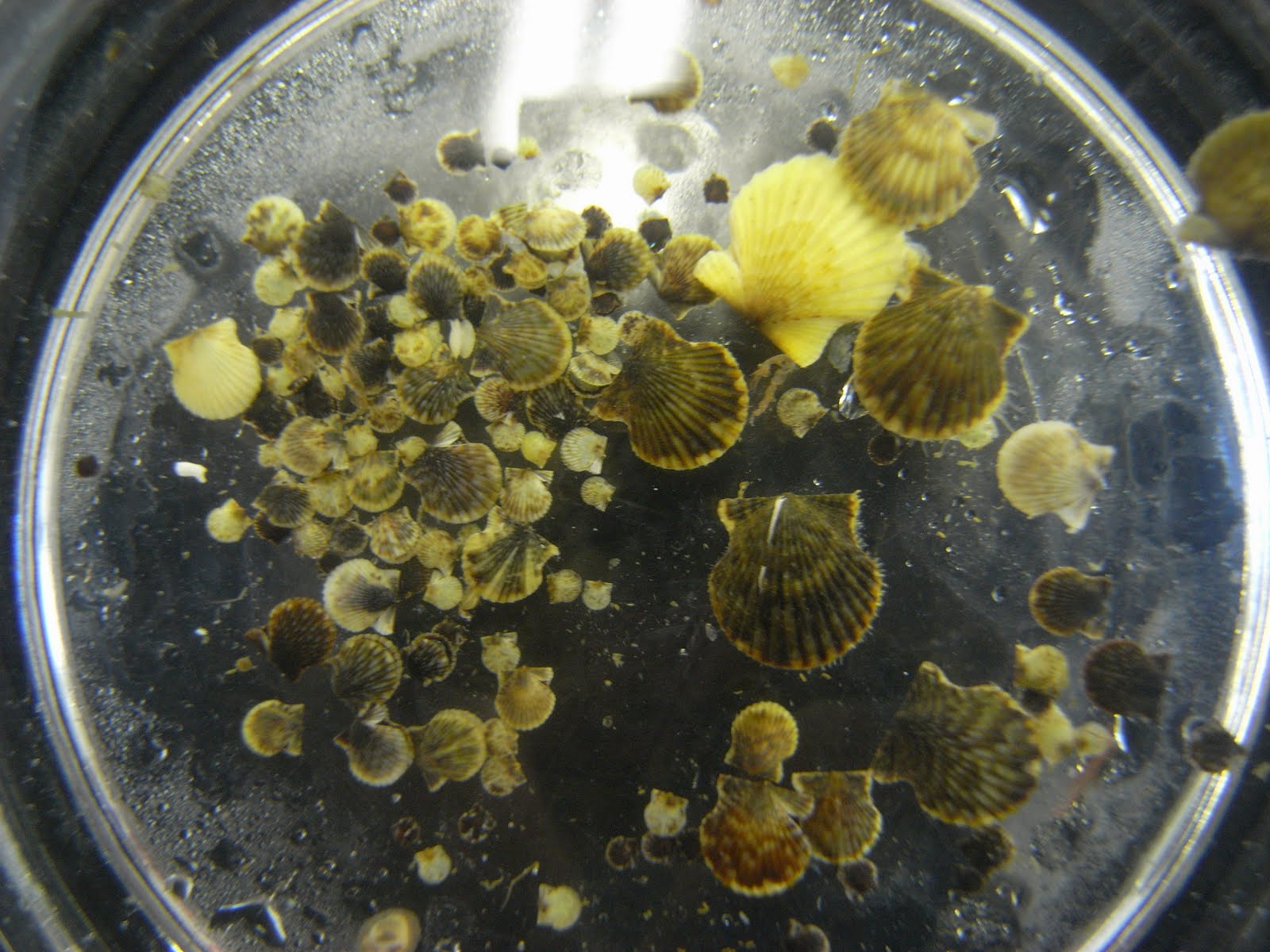
Although there are a lot of them associating with eelgrass beds in Shinnecock Bay, NY. Nope, I am hunting for baby scallops. Shinnecock Bay has some of the healthiest eelgrass meadows in Long Island, and in some places within the bay, new meadows are forming. This is great, as many species depend on seagrasses as predation refuges and nursery grounds, including my model organism, bay scallops. Why then are there apparently no scallops in Shinnecock Bay? Well, its not exactly that there aren't any, of course, but that there are so few, they might essentially be ecologically extinct. However, restoration efforts in the Peconics and larval monitoring have turned up some pretty exciting results. And, Shinnecock Bay is connected to the Peconics through a canal, whose gates are left open when there is a high tide in the Peconics, allowing water to flow into Shinnecock Bay. This is a potential source of scallop larvae. While the spawner sanctuaries are quite distant from the canal, there is a growing scallop population around Robin's Island in Great Peconic, not far from the canal. And either way, scallop larvae spend up to 2 weeks in the water column, so it is possible for fairly long distance dispersal. So I thought we might see some scallops in Shinnecock Bay. I certainly saw some juveniles last summer, but didn't see any adults, so their survival is likely very low. One reason is probably predation. The same eelgrass meadows that are valuable for scallops is also a valuable habitat for blue crabs and mud crabs, both of which eat scallops like popcorn (or at least I imagine that's how they eat them). And yet, no one has investigate either scallop or blue crab recruitment in Shinnecock Bay, so that's what I am currently doing. My scallop monitoring has already started, and surprisingly (or maybe not surprisingly), I didn't get the results I was anticipating. Instead of the highest numbers of scallops at the site closest to the canal and diminishing numbers with distance, I had two relatively high spat numbers sites, on either side of the Shinnecock Inlet, opening up to the ocean. Could this mean a possible oceanic transport of scallop larvae into Shinnecock Bay? Is this supply-side ecology? There are clearly not large numbers of larvae, but there is a supply, and it's coming from somewhere, but to be honest, I have no idea where. Soon I plan on sampling for blue crabs, whose larval origin I know is oceanic. If they display a similar settlement pattern, perhaps my question will be answered.

On a side note, we did collect a lot of other organisms. All together, over 20 different species of organisms came up on the collectors. The most abundant were scallops, mud crabs, blue mussels, jingle shells and slipper shells. But we also saw 2 types of sea squirts, bryozoans, rock crabs, 4 different species of snails, sea stars, urchins, other bivalves (arcs, angel wings and cockles), scaled worms and other polychaetes. Oh yeah, and a few of these things that I have as yet been unable to identify, although my guess is some sort of nudibranch. So yeah, exciting stuff indeed.

(scaled worm)

Wednesday, July 28, 2010

I need fish!!!!!!!!

Seriously, I need them... I have scallops, I have mesocosms, I have artificial seagrass, I have mud crabs. Check that, I don't have mud crabs. I need fish and mud crabs! Wow, who thought getting these things would be so difficult... Went out trawling today with a group of elementary school children on the RV Peconic out of the Southampton Marine Station... We caught some interesting fish, and we caught crabs, just not the ones I am looking for. Oh science, why must you be so difficult sometimes!

Ok, on a more serious note, I am sort of freaking out here. I just got scallops on Monday. They are already around 10-11 mm, and soon they will be too big (assume ~2mm growth per week at this time of year, maybe less in a flow through system). So I want to use them ASAP. In addition, Cochlodinium is blooming again in Shinnecock Bay. If it gets into our seawater system, my baby scallops are toast. Seriously, its bad. Read about it here, or here, or here if you don't want to take my word for it. So theres two reasons why I need to get started quickly, and yet, it seems unlikely that I will have either mud crabs (probably the most abundant crab out there, you would think I can get those easily) or fish to start my tri-trophic interaction experiments. Ideally, I would like to have tautog, scup and toadfish (which have received varying levels of fishing pressure, and each of which will likely have a differing impact on scallops and mud crabs). Ah well. Here's to keeping fingers crossed!